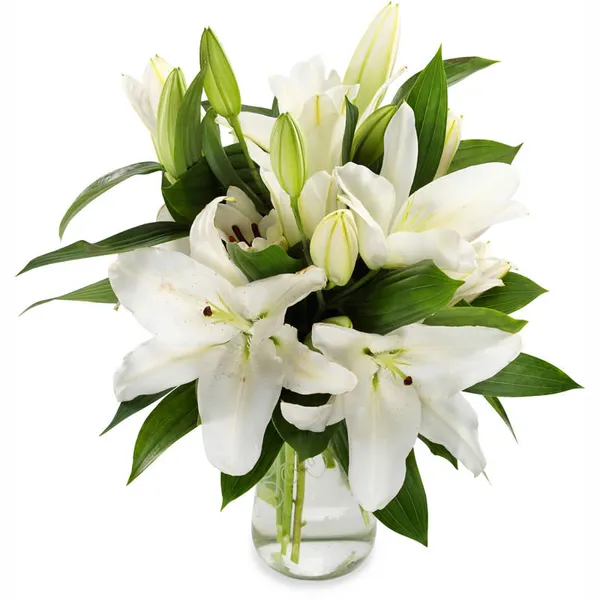
White Lilies
About Ikebana, the Japanese Art of Flower Arranging
You throw some flowers into a vase and they look good enough. A florist arranges a magnificent spread that fills the vase. Then, an Ikebana arrangement comes across your path, using only three stems and a whole load of space.
Join us below to discover Ikebana, the Japanese art of arranging flowers.
What does Ikebana mean?
Ikebana is the Japanese botanical practice of creating living compositions with cut flowers.
The word translates roughly to "living flowers" or "the way of flowers," coming from two Japanese words: "ikeru," to arrange or give life, and "hana," meaning flower.
The history and origins of Ikebana
The sixth century is when Ikebana is traceable to. Buddhist monks offered flowers at altars as part of their spiritual life. Those changed from simple flowers into an art form with principles over time.
It’s the 15th century when things changed, during which Ikebana spread into samurai households and the aristocratic world. The Ikenobo school, of Senkei Ikenobo, is its modern birthplace. 1462 is the year of the school’s first mention in texts.
The philosophy behind Ikebana
A later monk called Senno Ikenobo wrote a manuscript for Ikebana in 1542. That gave us Ikebana’s underlying philosophy today.
Restraint is Ikebana’s philosophy at heart, with Senno showing that even a stem, bud, or withered leaf has beauty. The composition of a floral display in Ikebana is not about bunching flowers. It’s about balancing its elements.
"Ma," or empty space, is the underlying secret to Ikebana, with arrangements using space to allow the eye to rest and mimic how things grow.

The main styles of Ikebana
Rikka. An upright, structured arrangement that’s the oldest and most formal style. The purpose is natural order.
Shoka, or Seika. An arrangement with three elements only, with those representing heaven, man, and earth.
Nageire. It puts the vase first, requiring a tall vase. There are no strict arrangement rules, with flowers able to appear thrown together.
Moribana. One of the modern Ikebana styles. It uses shallow and open containers with a spiked holder, called a Kenzan.
Jiyuka. No restrictions on containers, materials, or form, allowing the arranger complete freedom. Must still honour balance.
Key elements of an Ikebana arrangement
Line (Sen). This is the overall shape and direction of the arrangement – visually, it dictates the sense of movement and structure.
Space (Ma). Dictates the space between elements. The flowers, buds, stems, and additional elements have adequate distance.
Asymmetry. Mimics how plants grow with an uneven composition. Flowers and buds combine in short, tall, and withered forms.
Minimalism. One element rather than two, for instance, and each material is given attention so that stems, leaves, and branches have purpose.
Seasonality. Ikebana uses what’s available at the time. Dried flowers are also acceptable, as are seed-headed materials.
Container. Largely comes down to preference, but some Ikebana styles call for shallow, open, or tall vases.
Ikebana vs Western flower arranging
Ikebana favours restraint over abundance with a few stems, buds, and decorations. The asymmetry provides a natural composition, similar to that you’d find out in the wild, but with an artful balance.
Western flower arranging is about abundance, with symmetrical arrangements that pack out the vase. Abundance is the reason for fillers, such as ferns and eucalyptus, and it’s why bouquets often contain a dozen or more flowers.
It’s down to taste which you prefer. Ikebana is something you would do at home and practice; Western flowers are usually purchased from a florist.
Flowers in Ikebana
Cherry and plum blossoms are central to many Ikebana arrangements. Their pairings with grasses and seeds are ornamental and maximise space.
Lilies have a place as the focal point, particularly white varieties. Driftwood and branches are then added to frame the flower.
The peony is known as the "king of flowers" in the form of the tree peony, or Paeonia suffruticosa. You’ll find many traditional Moribana arrangements using these flowers.
Evergreen branches and dried flowers can be used throughout winter. The most important principle is to choose seasonal plants and let their natural shape guide the arrangement.

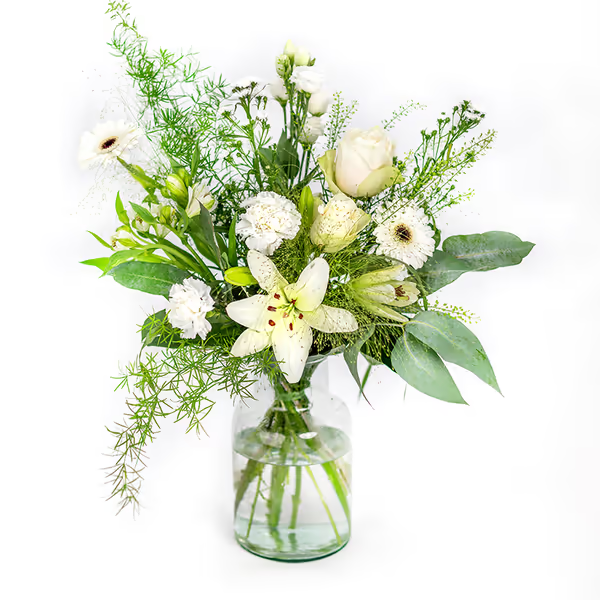
Bringing Ikebana inspiration into your own home
Practising Ikebana requires a few vases and cut flowers. Get these from your garden, from somewhere in nature, or from your florist. Each arrangement will use three to five stems and one or two structural elements, such as a stick.
The more interesting the lines, the more natural your Ikebana. A curved branch, tall and short contrasting stems, and withered leaves can provide a striking composition.
You want your arrangement as asymmetrical as it can get. That’s a somewhat foreign idea when most Western arrangements look so neat. With Ikebana, you need imperfection with different stem heights, leaf conditions, and space.
Your final Ikebana is to look calm rather than crowded.
Learn more about flowers in our flower encyclopedia.
Is ikebana a good gift for flower lovers and florists?
Yes, in our opinion, Ikebana course or a traditional Ikebana arrangement set makes a thoughtful gift for any flower lover. A beautiful Ikebana vase, a kenzan (the spiked flower holder used to secure stems), or a workshop led by an experienced instructor is perfect for anyone looking to deepen their floral skills. It's an especially meaningful gift for experienced florists and passionate flower enthusiasts who enjoy exploring new floral design techniques. That's why an Ikebana course is featured in our list of the best gift ideas for flower lovers.