

Door Wreath
When does Advent start in 2026? Advent traditions in Poland and abroad
Advent 2026 starts on Sunday, 29 November, and continues until Christmas Eve, 24 December. If you like to have your stunning Advent wreath ready for the first candle, these are useful dates to put in your diary before December gets busy.
For some people, Advent is primarily a time of spiritual preparation. For others, it also means floral decorations, making time for family and enjoying the small rituals that come before Christmas. So, does Advent begin on the same date in Poland, Germany and the UK? Here is how Advent is celebrated in Poland.
When does Advent start? How is the Advent date chosen?
Advent does not have a fixed starting date. In the Roman Rite, the first Sunday of Advent falls between 27 November and 3 December. Strictly speaking, Advent begins with First Vespers of the first Sunday of Advent (evening prayer on the preceding Saturday). In everyday use, however, Sunday is given as the starting date, and that is the date you will find in most calendars.
The date is determined by the rules of the liturgical calendar: the first Sunday of Advent is the fourth Sunday before Christmas. When Christmas Eve falls on a Sunday, it is also the fourth Sunday of Advent.
So why does the start of Advent change? Christmas is always celebrated on 25 December, but it falls on a different day of the week each year. The arrangement of Sundays in the calendar determines when the season begins. That is why we will light the first candle on the Advent wreath on 29 November in 2026, 28 November in 2027, and 3 December in 2028.
If you are wondering when Advent begins, do not simply look at the first day of December — sometimes the first candle on the wreath is lit while it is still November.
The familiar, commercial Advent calendar follows a slightly different timetable. Most versions sold in stores have 24 doors that run from 1 to 24 December, whatever the date of Advent Sunday. So opening the first door and lighting the first wreath candle will not always happen on the same day — both mark the anticipation, but they follow different calendars.
When does Advent start in 2026, 2027 and 2028?
The first Sunday of Advent in 2026 falls on 29 November 2026.
The first Sunday of Advent in 2027 falls on 28 November 2027.
The first Sunday of Advent in 2028 falls on 3 December 2028.


When does Advent end?
That's pretty simple: Advent ends on 24 December, before First Vespers of Christmas. It does not continue until midnight: the evening celebration already belongs to the Christmas season. Christmas Eve therefore marks a transition from preparing for Christmas to celebrating it.
Does Advent fall on the same dates in Poland and abroad?
Roman Catholics following the Roman Rite observe the same Advent dates in e.g. Poland, Austra, Germany and the UK. The Church of England also follows the same dates for Advent Sunday. If your family lives across these countries, you can light the first candle on the same day, even when you cannot be in the same room.
Send a stunning, fresh wreathSend a stunning, fresh wreath
Who loves the Christmas countdown? Surprise your loved ones in Poland with one of our stunning wreaths prepared by our experienced florists.
Send Advent wreathsAdvent in Poland: How is it celebrated?
Lanterns, Roraty and seasonal decorations.
One distinctive Polish Catholic tradition is Roraty: Masses in honour of the Virgin Mary, traditionally celebrated early in the morning. Children bring lanterns, and candlelight expresses hope as Christmas approaches. For many families, the experience also brings lasting memories of leaving home in the dark and sharing a small ritual that makes these weeks feel different from the rest of the year.
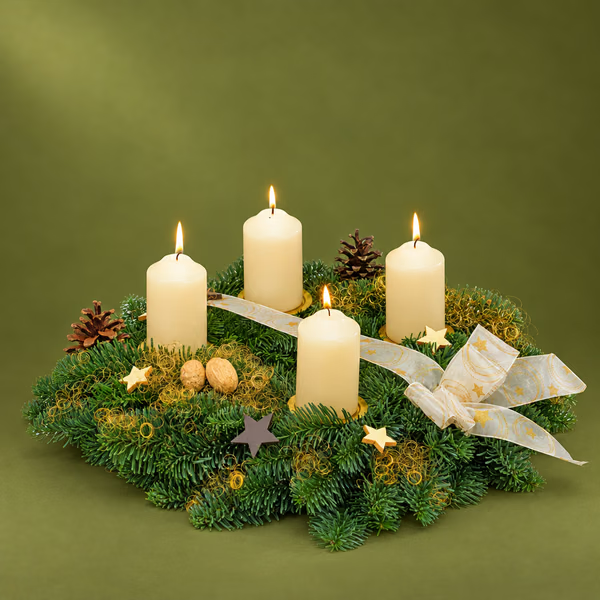
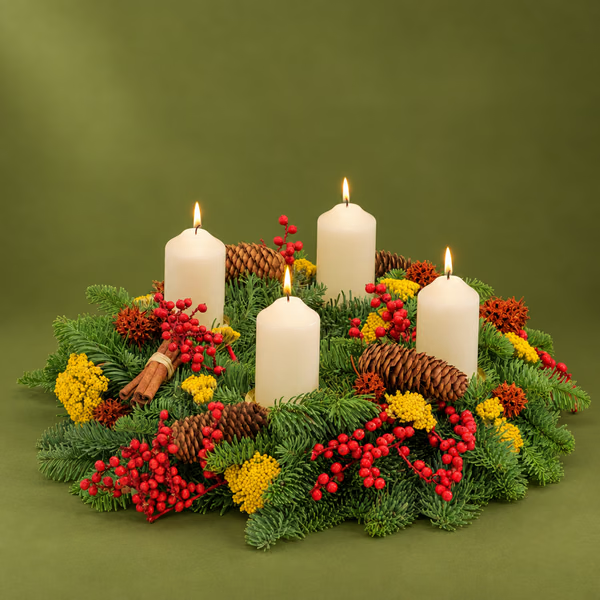
Preparations also take shape through decorations. Every year, from early November, we see people looking for ready Advent wreaths with delivery on the Euroflorist website, alongside wider online searches for church Advent wreaths ("wieńce adwentowe"), Advent table wreaths and Advent arrangements with candles. Some people call them Advent table centrepieces ("stroiki adwentowe"). The defining feature of a traditional Advent wreath is its four candles, representing the four Sundays of Advent. A general Christmas wreath does not need candles and can decorate a door, wall or table throughout the festive season.
At Euroflorist, our beautiful collection of fresh evergreen wreaths and seasonal decorations can be sent to loved ones throughout Poland even on the same day.
Advent around the world - how others celebrate it?
Which countries hold early-morning Advent Masses?
Early-morning Advent Masses are a tradition in several European countries, including Poland, where they are known as Roraty. Similar celebrations also take place further afield, bringing people together before sunrise to prepare for Christmas. Some share the same roots as Polish Roraty, while others developed as distinct local traditions.
-
Czechia — “roráty”: early-morning Advent Masses, often celebrated by candlelight and accompanied by traditional Czech Advent hymns
-
Austria — “Roratemessen”: Advent Masses celebrated early in the morning by candlelight
-
Germany — “Roratemessen”: a tradition found particularly in regions such as Bavaria, where worshippers gather for candlelit morning Masses during Advent
-
Switzerland — “Rorate”: early-morning Masses or prayer services by candlelight, sometimes followed by a shared breakfast
-
Hungary — “roráte”: Advent Masses at dawn, associated with devotion to the Virgin Mary and preparation for Christmas
-
Croatia — “zornice”: early-morning Advent Masses belonging to the same tradition as Polish Roraty. Their name refers to dawn
-
Portugal, particularly Madeira — “Missas do Parto”: a distinct tradition of nine early-morning Masses before Christmas, usually held from 16 to 24 December. The name literally means “Childbirth Masses” and refers to the Virgin Mary awaiting the birth of Jesus
-
The Philippines — “Simbang Gabi”: a separate tradition of nine Masses, traditionally celebrated at dawn from 16 to 24 December, although evening celebrations also take place. Introduced by Spanish missionaries during the colonial period, the custom became a cherished part of Filipino Christmas preparations. The early hour allowed farmers to attend before beginning their work in the fields.
Advent traditions around the world
Advent can mean early-morning church services, candles glowing in windows or a Sunday afternoon spent sharing something freshly baked. Germany and Austria have strong traditions of wreaths and Christmas markets, while Sweden and Denmark bring their own rituals of light into the darkest weeks of the year. Some customs are religious; others belong to the wider Christmas countdown and are enjoyed by families regardless of church attendance.
Advent in Germany: candlelight and time together
In Germany, the countdown to Christmas is centered around the "Adventskranz" (Advent wreath), a cozy household tradition originating in 1839. It is crafted from circular evergreen branches that symbolise eternity. The wreath holds four candles, one for each Sunday leading up to Christmas Eve. Every Sunday, families gather to light an additional candle, creating a warm, growing glow throughout December while sharing Christmas cookies and occasionally singing carols to welcome the holiday season.
Advent in the UK: music and gatherings by candlelight
In the UK, including within the Church of England, Advent carol services bring together seasonal singing and Bible readings. Music offers a shared way to prepare for Christmas, creating an atmosphere that people can experience together. Compared with Poland’s early-morning Roraty, the emphasis feels different, while the sense of gathering remains familiar.
Christingle celebrations also give candlelight a special place in the season. They can take place during Advent or later in the wider Christmas period. At home, Advent calendars offer another kind of ritual: a small daily moment of anticipation that adults can enjoy just as much as children.
Advent in Austria: flowering branches and Saint Barbara’s Day
Austria’s Advent traditions offer a striking contrast between gentle domestic rituals and dramatic outdoor celebrations. On Saint Barbara’s Day, 4 December, people traditionally bring branches from fruit trees, such as cherry or apple, indoors and place them in water. Known as Barbarazweige, these bare branches are encouraged to blossom around Christmas — a different kind of seasonal decoration, with the anticipation built into it.
Advent in Denmark: candle countdown
In Denmark, candlelight is part of Christmas hygge (the feeling of comfort and togetherness that makes a winter evening inviting). A distinctive tradition is the calendar candle, burned a little each day through December. Instead of opening a door and finishing the countdown in seconds, families can let the candle mark the passing days while they sit together.
Advent in Sweden: glowing windows and Saint Lucia
In Sweden also, the four Sundays of Advent are occasions to pause and spend time together. Wreath candles are lit each Sunday, while illuminated Advent stars brighten windows. Gingerbread biscuits and saffron buns called lussekatter add something sweet to the preparations. It is easy to see the appeal: when daylight is scarce, even a small pool of warm light can make coming home feel special.
One of Sweden’s most distinctive December celebrations is Saint Lucia’s Day on 13 December. Processions feature white-robed singers, led by a Lucia figure wearing a crown of candles or electric lights. Although Lucia is a separate celebration that falls during Advent, it has become an important part of Sweden’s Christmas season.

Do Advent wreaths look the same around the world?
Advent wreaths come in many styles, but the traditional design shares one defining feature: four candles, representing the four Sundays of Advent. Beyond that, the shape, colours and decorations leave plenty of room for local tastes and personal touches.
In Poland, a classic look often features a full ring of fresh evergreen branches with thick pillar candles, ribbons, pine cones and red or gold accents. The result is a generous, decorative centrepiece that brings a festive feel to the table. Scandinavian-inspired designs tend towards simplicity: lighter arrangements of greenery, natural textures and fewer ornaments. Tall, slender candles rise noticeably above the branches, making candlelight the focal point rather than the surrounding decorations.
These are preferences rather than strict national rules. A modern Polish home might favour an understated wreath, while a Scandinavian family might choose rich colours and decorative ribbons. Some arrangements also move away from the circular shape, placing four candles in a row or grouping them on a tray with greenery.
Whether traditional, colorful or contemporary & minimalistic, the loveliest design is one that suits your home and makes you want to gather around it. You can order ready-made Advent wreaths online from Euroflorist for delivery throughout Poland. Or why not try making your own? Our florist Sofia shows you how:
See also:
- How to make an autumn/winter wreath with eucalyptus leaves
- How to make a modern Christmas wreath
- How to get amaryllis to bloom for Christmas
- Decorating the Christmas table with amaryllis
- How to make a Christmas centrepiece step by step
Order ready-made: Advent wreaths, Poinsettias, Christmas flowers, Christmas centrepieces, Christmas flower boxes