Iris: The Noble and Symbolic Flower

The iris is an elegant and fascinating flower, admired for its striking petals and deep symbolic meaning. Representing wisdom, hope, and courage, it is often associated with royal dignity. Irises come in a wide range of colours, including blue, purple, yellow, white, and even bi-coloured varieties. Originally from Europe, North America, and Asia, the iris is a popular choice for both gardens and floral arrangements. Its name derives from the Greek word for "rainbow," highlighting its vast colour diversity.


purple iris on a grey background
Fact icon

COMMON NAME

Iris

Fact icon

BOTANICAL NAME

Iris spp.

Fact icon

ORIGIN

Europe, North America, Asia

Fact icon

PEOPLE ALSO CALL IT

Flag Iris

Fact icon

FLOWERING TIME

Spring to early summer (April to June)

Fact icon

ASPECT

Full sun to partial shade

Fact icon

SYMBOLISM

Wisdom, hope, courage, faith, royalty

Care Tips for Cut Iris in a Vase

Trim Stems at an Angle: Cut the stems diagonally to enhance water absorption.

Use Fresh Water: Change the water every two days and use flower food to extend the vase life.

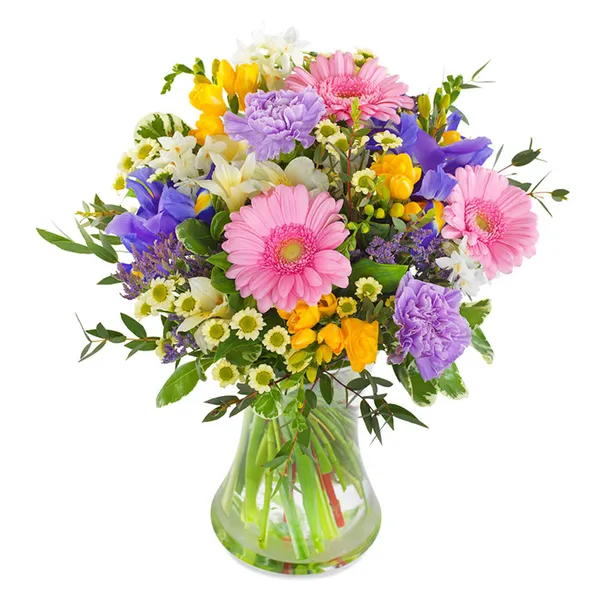
Choose a Deep Vase: Iris stems are delicate and require support in a tall vase.

Avoid Direct Sunlight: Place the vase in a cool, shaded area to keep the flowers fresh for longer.

Keep Away from Ethylene-Producing Fruits: Store irises away from ripening fruit, as ethylene gas can shorten their lifespan.


Symbolism & Meaning

The iris carries a rich symbolic history. In many cultures, it represents wisdom, hope, and courage. n Christian tradition, it is often linked to faith and divine protection. The colours of the iris also hold specific meanings—blue irises symbolise trust and wisdom, yellow irises represent friendship and joy, white irises signify purity and hope, while purple irises convey spirituality and admiration.

Types of Iris

There are many different types of irises, each with unique characteristics for gardens and arrangements. Bearded Iris (Iris germanica) is one of the most well-known varieties, featuring velvety, dramatic petals in bold colours. Siberian Iris (Iris sibirica) has slender leaves and delicate, elegant flowers. Japanese Iris (Iris ensata) is renowned for its large, flat blooms, often planted near water features. Dutch Iris (Iris x hollandica) is a popular cut flower with sleek petals and vivid hues. Each variety brings its own distinct beauty and charm to floral displays and landscapes.

Iris or Kosaciec — What Do We Call It In Poland?

In Poland, the same flower goes by two names that are used interchangeably — and both are correct. Irys derives directly from Latin and Greek — from the name of the goddess Iris, personification of the rainbow, reflecting the extraordinary range of colours in which this flower appears. This form dominates in floristry, flower shops, and urban everyday language. Kosaciec, on the other hand, is the traditional native Polish botanical name — widely used in gardening, nature writing, and among older generations. Interestingly, the word kosaciec is rooted in the Polish word kosa (scythe) — a reference to the long, sword-like leaves of the plant, which resemble the blade of a scythe in shape. In practice, both names are used interchangeably.

Frequently Asked Questions About Iris

Bearded iris (Rhizomes): Best planted in late summer to early autumn (July-September), allowing roots to establish before winter.

Bulbous iris (Dutch iris, Reticulata iris, etc.): Should be planted in autumn (September-November), about 4-6 weeks before the first frost.

In mild winter regions, both types can also be planted in early spring, but autumn planting is preferred for stronger blooms.

For bearded iris (Rhizomes):

  1. Choose a sunny location – Iris needs at least 6 hours of sunlight per day.
  2. Prepare the soil – Use well-draining soil; sandy or loamy soil is ideal.
  3. Planting depth
    • Plant rhizomes shallowly, with the top slightly exposed or just below the surface.
    • If buried too deep, they may not bloom.
  4. Spacing – Keep 30-40 cm between plants for airflow and healthy growth.
  5. Watering – Water lightly after planting, then only when needed to avoid rot.


For bulbous iris (Dutch iris, Reticulata iris, etc.):

  1. Plant bulbs 8-10 cm deep, with the pointed tip facing upwards.
  2. Space them 10-15 cm apart in well-drained soil.
  3. Mulch lightly in winter in colder climates to protect them.
  4. Water after planting, but avoid overwatering.
  • Deadhead spent blooms to prevent seed formation and encourage energy storage for next year.
  • Leave the foliage intact until it turns yellow; the leaves help the plant store nutrients.
  • For bearded iris:
    • Trim the leaves to about 15 cm in late summer to keep the plant tidy.
    • Every 3-5 years, divide overcrowded rhizomes in late summer to maintain vigorous blooming.
  • For bulbous iris:
    • Let the foliage die back naturally.
    • If growing in pots or cold regions, lift bulbs and store them in a cool, dry place until replanting in autumn.

Bearded iris: Blooms in late spring to early summer (May-June). Some varieties rebloom in late summer.

Bulbous iris (Dutch iris, Reticulata iris, etc.): Blooms in early to mid-spring (March-May), depending on the variety and climate.

Siberian iris & Japanese iris: Bloom in late spring to early summer (May-July).

The scent of iris flowers varies by variety:

  • Bearded iris: Has a fragrance ranging from sweet and floral to grape-like or citrusy.
  • Bulbous iris (Dutch iris): Often has a light, fresh floral scent.
  • Iris pallida (Orris root iris): Has a powdery, violet-like fragrance, often used in perfumes.
  • Siberian iris & Japanese iris: Usually little to no fragrance.

Irises (known in Poland also as kosaćce) are available in Polish florists mainly in spring — from March to June, depending on the variety. Dutch irises are the most commonly found cut flower variety and are widely available from March onwards, making them one of the first vibrant spring flowers to appear in Polish florists after winter. They are popular for Easter arrangements, spring bouquets, and as a thoughtful gift expressing wisdom and hope. Outside the spring season, irises are rarely available as cut flowers in Polish florists. If you want to be notified about iris availability, simply subscribe to our newsletter — we regularly announce the availability of seasonal flowers.

Yes — and this is one of the lesser-known facts about irises. The dried and powdered rhizome of Iris pallida and Iris germanica, known as orris root, has been used in perfumery for centuries. It has a distinctive powdery, violet-like fragrance and is used as a fixative in many classic perfumes, helping other scents last longer. Orris root is one of the most expensive natural perfumery ingredients in the world, as the rhizomes must be dried for 3–5 years before processing. Many iconic perfumes contain iris or orris root as a key note.

Author

David Denyer

Euroflorist's Flower Expert

With over 35 years of floristry experience, David Denyer is a renowned master in his field. His talent and artistic vision have earned him numerous accolades and awards, establishing him as one of the industry's leading figures. David has captivated audiences worldwide, showcasing his passion for floristry in Europe, China, Australia, and America. His captivating demonstrations have left a lasting impression on floral enthusiasts globally. In 2023, David made a memorable appearance on the prestigious television show, Gardeners World, further solidifying his reputation as an exceptional florist. David's journey to success began in 1996 when he was named Interflora "Florist of the Year." Since then, he has represented the United Kingdom in the "Europa Cup" and achieved consecutive Chelsea Gold Medals and Best in Show titles at the renowned Chelsea Flower Show from 2000 to 2003. In July 2004, David was once again named Interflora "Florist of the Year" and led his team to victory at the Interflora World Cup in Melbourne, Australia. He continued to impress with another Chelsea Gold Medal in 2005 and received a Gold Medal in 2011 for his floral installation titled "A Sense of Perspective." David's Accolades: July 1996: Interflora "Florist of the Year"; September 1999: Represented the UK in the "Europa Cup" in Austria; May 2000-2005: 6x Consecutive Chelsea Gold Medal and Best in Show - Professional Floristry; July 2004: Interflora "Florist of the Year"; September 2004: Interflora World Cup Winners in Melbourne, Australia; 2011: Chelsea Gold Medal for "A Sense of Perspective" floral installation; 2023: Appeared on Gardeners World in 2023; David's vast experience and expertise now benefits Eflorist customers. Understanding the emotional power of flowers, he ensures that every customer receives the utmost delight when enjoying their thoughtfully sent bouquet.