

Autumn Colors
Winter favourites: Ilex vs Hypericum. How to tell them apart?
Red berries are a festive favourite, adding a beautiful pop of colour to Christmas bouquets, wreaths and centrepieces. But not all red berries are the same! Two popular choices in seasonal floral arrangements are Ilex (holly) and Hypericum (St. John’s wort). While they may look similar at first glance, each has its own distinctive characteristics.
So, how can you tell them apart?
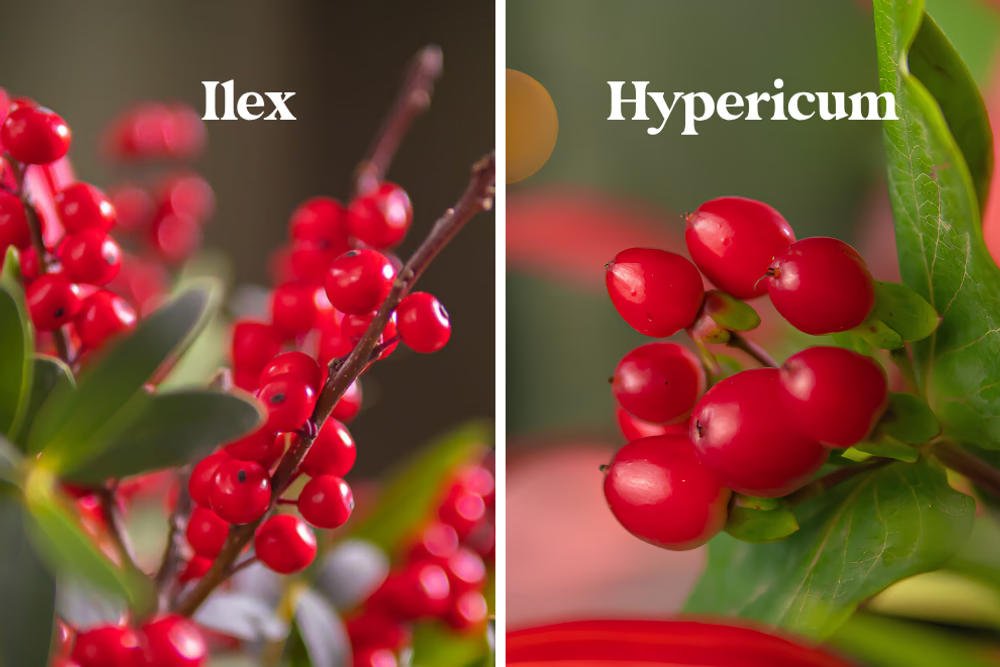
During the winter months, florists often hear the same request: “Could you add some of those little red berries to my bouquet?” But which red berries do customers actually mean?
Two festive favourites, Ilex (holly) and Hypericum (St. John’s wort), are often mistaken for one another. Both bring a cheerful splash of red to Christmas bouquets and winter arrangements, but they’re quite different once you know what to look for.
What is Ilex?
Ilex is the Latin name for holly, and there are hundreds of species of it. You probably know English holly the best, with its spiky leaves that you see on Christmas cards.
In floristry, "Ilex" usually means Ilex verticillata. It’s also known as winterberry or deciduous holly. It drops its leaves in autumn and leaves bare branches covered in berries. Those are the stems you see in florists' buckets from autumn onwards.
Ilex berries are usually red, but you can also find orange and yellow varieties.
What is Hypericum?
Hypericum also has berries and is often confused with Ilex for that reason. It’s the same plant group as St John's wort. The kinds florists use have yellow summer flowers followed by glossy berries that start green and turn red by autumn.
Florists use Hypericum as a filler with popular flowers such as roses. The berries add colour and texture between the main flowers in a bouquet. It comes in a much wider range of colours than Ilex and is available all year.




How to tell Ilex and Hypericum apart
They come from different plant families, grow in different ways, and have different seasons, although both are used as fillers in floral bouquets.
| Criteria | Ilex | Hypericum |
|---|---|---|
Plant | Holly | St John's wort family |
Leaves | Usually none | Green, oval, in pairs |
Berry position | Round | Oval, often pointed |
Berry position | Along the branch | Clusters at stem tips |
Base of berry | No green cup | Green star-shaped cup |
Stem | Woody branch | Leafy stem |
Colours | Red, orange, yellow | Red, pink, peach, white, green, brown, black |
Season | Autumn to winter | All year |
The first difference is that Ilex branches are usually bare without any green leaves, whereas Hypericum stems have small oval leaves in pairs.
Their berries are also different. Ilex berries grow tight along the length of the branch, often packed so close together that you can barely see the wood. Hypericum berries grow in clusters at the ends of the stems, a bit like grapes.
Ilex berries are round, like a small pea. Hypericum berries are oval or egg-shaped and come to a small point at the tip. Turn a Hypericum berry over, and you'll see a small green star of sepals holding it, like a cup. Ilex berries sit straight on a short stalk, with no green cup.
Seasons and availability
Hypericum is grown all year and is most popular in autumn and winter for its red and brown shades, and in spring and summer for its pinks, whites, and greens.
Ilex is seasonal and only available in autumn and winter. You'll find it in florist shops from around September to January.
Both are tied closely to Christmas flower displays and wreaths. Neither is more Christmassy than the other, so pick whichever you like when it’s the season to be jolly.
How florists use them
Florists use Ilex and Hypericum stems as fillers, with Ilex also used as a feature stem in some arrangements. They pair well in mixed bouquets with carnations, roses, and chrysanthemums.
Ilex
- Tall vase arrangements, where the long branches can stand on their own
- Christmas wreaths and door displays
- Table centrepieces, often with pine, eucalyptus, and pinecones
- Stems that need to last, since Ilex berries hold on well
Hypericum
- Filler in bouquets, between roses, carnations, and other main flowers
- Buttonholes and wedding flowers
- Autumn bouquets in reds, oranges, and browns
- Christmas bouquets, where red Hypericum gives a similar look to holly on a shorter stem
Caring for Ilex and Hypericum at home
Ilex and Hypericum from a florist should look their best for up to two weeks. When you get them home, cut the stems at an angle and stand them in fresh water.
Strip any Hypericum leaves that sit below the water line and change the water every couple of days. You can also use Ilex branches dry in wreaths and garlands.
The berries from both plants are toxic to humans and pets. A good place to keep them is a table that a child won’t get on to. Pick up berries that fall on the floor and dispose of them in the bin to be safe.
Bring winter berries home
Our Christmas flowers use seasonal stems and berries to bring colour to your home over the winter. Order for yourself or send them to someone else, with same-day flowers arriving on the day you order, or the next day if you order after the cut-off time.
More about popular Christmas flowers: Hypericum (St John's Wort) Amaryllis Christmas Rose (Helleborus) Poinsettia